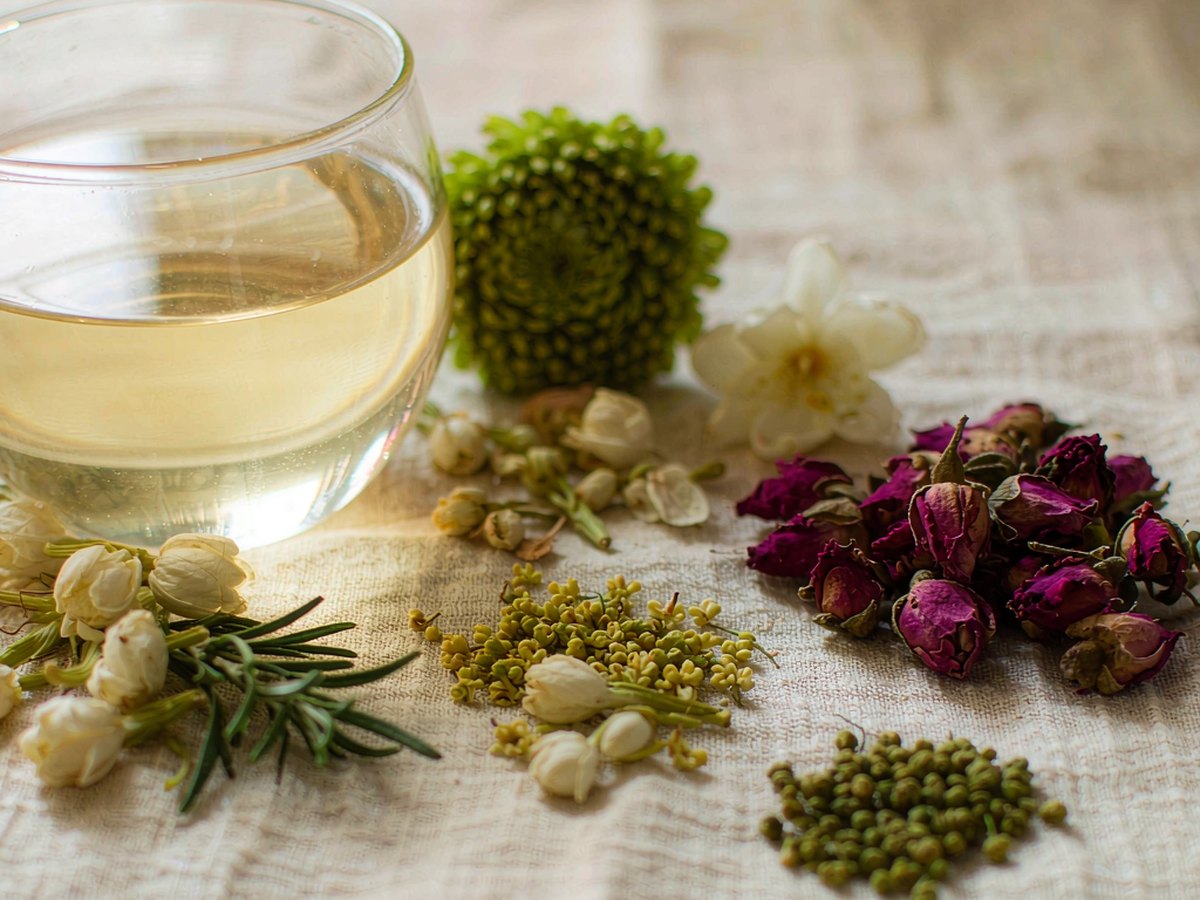
A blend of dried flowers is the easiest thing in this shop to make and the easiest thing to get wrong, because flowers do not behave like other herbs. They carry their aroma in the petal, they release it in minutes rather than minutes-to-hours, and they will happily take over a blend and leave the other ingredients with nothing to do. The good floral blends are built, not poured together.
- What it is
- Dried whole flowers and floral botanicals in their intact bloom form, blended or kept separate for building a tea at home.
- The principle
- One base flower for body, one accent flower for character, one aromatic for lift. Three is a working blend; five is a scented water.
- Extraction time
- Short. Most flowers give their colour and scent in 3–5 minutes and then begin to turn bitter and tannic.
- Water temperature
- Just off the boil for most. Boiling water scorches the petals and drives off the top notes you paid for.
- Ratio
- Start at 3 parts base to 1 part accent to a pinch of aromatic, and taste as you go.
- Keeps
- 12–18 months sealed and dark. Flowers are the fastest-aroma-loss material in the shop.
Why flowers need a different method
The chemistry of a flower is stored in the petal, and the petal is fragile. Unlike a root, which resists extraction until you give it heat and time, a flower gives everything it has almost immediately — colour, scent, tannins — and then keeps giving, but what it gives next is bitterness and a flat, dried-out astringency.
This is why a floral tea left on the brew for fifteen minutes tastes so different from one steeped for four. The four-minute cup is floral. The fifteen-minute cup is tannic. And because the material is whole and intact, those compounds leach evenly and quickly, with no way to slow them down except by taking the flowers out.
The second difference is quantity of aroma per gram. A small amount of good jasmine can carry an entire pot. A large amount will not make it better, and there is a specific point where the cup stops tasting like tea and starts tasting like a potpourri. Once you cross it, adding more leaf to compensate only makes it worse.
The three-part structure
The most reliable way to build a floral blend is to give each ingredient a job. The base flower provides the body and the colour — chrysanthemum, jasmine, honeysuckle and osmanthus are the usual choices, and they are the ones that make a cup look and read as tea. The accent flower provides character and a different note — rose for a romantic note, lotus for a cool and slightly sweet note, magnolia for something creamy and green. The aromatic provides lift and takes the edge off — a small piece of chen pi, a slice of dried ginger, or a fragment of osmanthus wood.
The working ratio is roughly three parts base, one part accent, and a small pinch of aromatic — a few pieces of peel rather than a spoonful. The aromatic is the ingredient most often overdone, because peel and ginger are strong and the instinct is to add more.
And then there is the order of operations that matters more than the ratio: put the base in first, give it a minute, then add the accent, and add the aromatic last of all, off the heat. A blend added all at once has no structure, because everything finishes extracting at the same time and the cup has one flat flavour instead of a sequence.
Reading a blend by eye before you brew it
Loose-leaf blends have a physical signature that predicts how they will taste, and it is worth learning because it saves you the experiment. Look at the colour of the dry leaf: a blend that is mostly yellow and white will taste light and clean, a blend with a lot of red or deep brown will taste fuller and more tannic, and a blend with visible dark petals in quantity will be heavy.
Look at the size of the pieces. A blend of whole, large, unbroken pieces will extract slowly and evenly. A blend that is already torn into small fragments will extract fast and can turn bitter within minutes.
Look for dust. A blend with a fine powder at the bottom of the bag has been handled roughly, and it will brew cloudy and can taste flat. A clean blend of recognisable pieces is usually a better-made blend, and it is much easier to adjust once it is in the pot.
Storage is the half of blending that gets skipped
Aromatics are volatile, and a floral blend is the most volatile thing you can buy. Blends are usually sold in a bag, and a bag is a bad home for them: it lets light in, it lets aroma out, and it offers nothing at all against moisture.
If you buy a blend you intend to finish, move it into a jar straight away — a glass jar with a tight lid, kept somewhere dark, is the difference between a blend that still smells like flowers in March and one that smells like dusty paper. This is the single highest-value thing you can do with any floral material in your kitchen, and it takes thirty seconds.
If you buy a blend to use occasionally, buy less of it. Blends bought in bulk and used slowly are the saddest thing in a tea cupboard, and they are usually bought by people who assume that more tea is more value, when for a floral blend it is close to the opposite.
What it is used for
- Aromatic drinking The primary use of a floral blend is to make a cup that is pleasant enough to drink without sugar and pleasant enough to drink at a desk, which is most of what a daily cup has to do.
- Colour and appearance Flowers are the only ingredient that makes a cup look like a specific kind of tea, and the visual is part of the drink in a way that other herbs do not manage.
- Scent in a room A dry blend kept in an open jar near the kettle gives off a faint fragrance that is a genuine part of the pleasure, and it costs nothing.
- Cold brewing Flowers are the best material for a cold brew, because six hours in cold water extracts their scent without the tannins that come with hot water and long steeping.
- Blending to taste Buying separate flowers and building the blend yourself is the only way to get a ratio you actually like, and it takes about thirty seconds once you know the structure.
- Blending into food Dried flowers are used to scent sugar, tea biscuits and confections, where heat and time release what the mill and the air took away.
In the kitchen
- The three-part base Three parts chrysanthemum or jasmine, one part rose or lotus, and a small piece of chen pi. Steep the base first, add the accent at one minute, the peel last.
- Cold brew, overnight A generous spoonful in cold water, left in the fridge overnight. The best method for flowers by a wide margin, and no bitterness at all.
- A three-minute cup Three grams in 200 ml just off the boil, and take the flowers out after three minutes. The aroma is at its peak and the tannins have not started.
- As a scent for sugar A few petals mixed into caster sugar, left covered for a week, then sieved out. The sugar keeps the scent for months.
- In tea biscuits Chopped petals in a plain shortbread dough. They go translucent and pretty in the oven and the flavour survives the baking.
- Rebuilding a blend that has gone flat If your blend has lost its scent, add a small amount of fresh osmanthus or jasmine to the jar rather than buying a new blend. It costs very little and it restores the top note.
The caution with floral material is mostly about the two things people forget: pesticides, which concentrate in flowers because they are the most exposed part of the plant, and the fact that a floral blend is usually several herbs at once, so you cannot always identify which one is reacting.
A
n
y
o
n
e
a
l
l
e
r
g
i
c
t
o
r
a
g
w
e
e
d
o
r
t
o
t
h
e
d
a
i
s
y
f
a
m
i
l
y
s
h
o
u
l
d
t
r
e
a
t
a
l
l
c
h
r
y
s
a
n
t
h
e
m
u
m
–
f
a
m
i
l
y
f
l
o
w
e
r
s
w
i
t
h
c
a
u
t
i
o
n
,
s
i
n
c
e
t
h
e
y
c
r
o
s
s
–
r
e
a
c
t
.
I
f
y
o
u
a
r
e
p
r
e
g
n
a
n
t
o
r
t
a
k
i
n
g
m
e
d
i
c
a
t
i
o
n
,
n
o
t
e
t
h
a
t
a
b
l
e
n
d
c
a
n
c
o
n
t
a
i
n
s
o
m
e
t
h
i
n
g
t
h
a
t
a
s
i
n
g
l
e
h
e
r
b
d
o
e
s
n
o
t
,
a
n
d
t
h
e
c
o
m
b
i
n
a
t
i
o
n
i
s
h
a
r
d
e
r
t
o
r
e
a
s
o
n
a
b
o
u
t
.
A
n
d
i
f
y
o
u
a
r
e
s
e
n
s
i
t
i
v
e
t
o
s
t
r
o
n
g
f
r
a
g
r
a
n
c
e
,
s
t
a
r
t
w
i
t
h
a
s
m
a
l
l
a
m
o
u
n
t
r
a
t
h
e
r
t
h
a
n
a
f
u
l
l
s
p
o
o
n
f
u
l
.
Disclaimer
A floral blend is a pleasant drink, not a treatment. Blending several herbs together makes it harder to know what any individual ingredient might do, and nothing in this article is a claim that any flower will treat, prevent or cure a condition. Please talk to your doctor or pharmacist before making any herbal blend a daily habit, particularly if you are pregnant or nursing, take prescription medication, manage a chronic condition, or are giving herbs to a child.