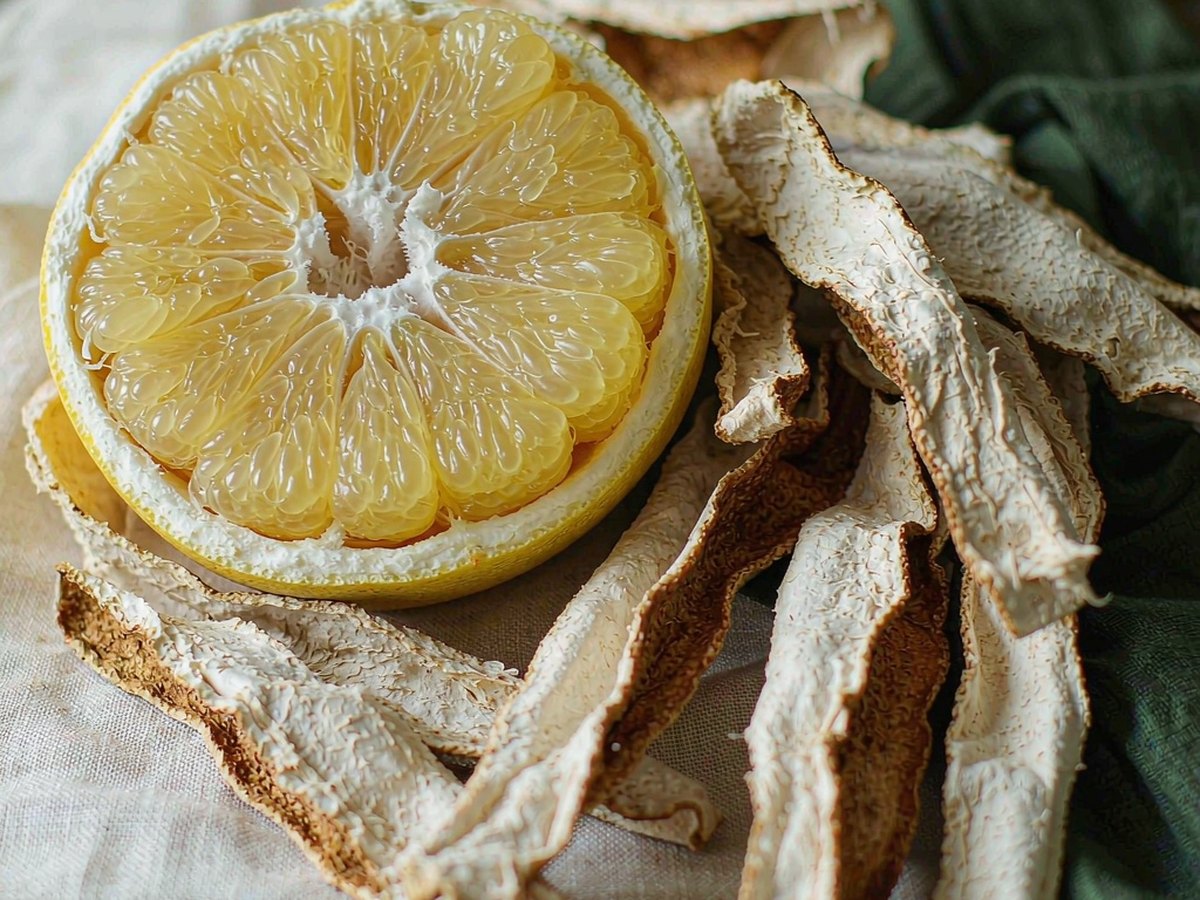
The pomelo is the largest of the citrus family, and its peel is the most powerful of the Chinese citrus peels in the pharmacy. Aged tangerine peel is a gentle aromatic; green tangerine peel is a sharp one; pomelo peel is blunt, drying and forceful, and it is used for the heavy, wet kind of chest congestion that nothing gentle will shift.
- Botanical
- Citrus grandis (Citrus maxima) — the pomelo, also written Citrus paradisi in older botanical literature. A distinct species from Citrus reticulata, the tangerine.
- Part used
- The dried outer peel (Exocarpium Citri Grandis), usually cut into strips. The thick white pith beneath is removed and is not the medicinal part.
- Origin
- Guangdong, Guangxi, Sichuan, Zhejiang and Hunan. Cantonese and southern Chinese tradition is the strongest user of it.
- Flavour
- Bitter and strongly aromatic, with a deep citrus base and very little sweetness. Much more medicinal-tasting than chen pi.
- Use
- 2–3 g per 200 ml, and almost always decocted — simmered 15–20 minutes. Infusing it barely extracts anything useful.
- Keeps
- 18–24 months sealed. Thick dry peel keeps very well, but it must not be allowed to reabsorb moisture.
A different species, a different action
Pomelo peel is not the same plant as tangerine. In the Chinese pharmacopoeia they are separate entries with separate indications, and confusing them is a genuine error. Citrus reticulata gives you chen pi and qing pi; Citrus grandis gives you hua ju hong.
The difference in the material is obvious once you break it. Pomelo peel is very thick, hard, and fibrous, with a deep orange-brown outside and a pale, dense pith behind. Aged tangerine peel is thin, pliable, and has darkened and sweetened with years of storage.
The difference in the traditional action matches. Hua Ju Hong is described as strongly drying, strongly bitter and strongly aromatic, and it is used for what traditional medicine calls phlegm-damp in the chest — a cough with a lot of mucus, a chest that feels heavy, a sticky mouth. It is one of the strongest drying and transforming herbs in the citrus family.
Where it comes from in the formula
Pomelo peel appears in the classical formula Huo Xiang Zheng Qi San, the Patchouli Corrective Qi Powder, which is one of the most-prescribed digestive formulas in the Chinese pharmacy. It appears there alongside Huo Xiang, the patchouli, Chen Pi, Sha Ren and the rest — a blend used for exactly the picture of a blocked, heavy, damp digestion with nausea.
It is also a component of the modern Chinese patent medicine Xuan Fu Zhi Li Wan, widely taken in China and East Asia for what is described as stomach and intestinal symptoms, and in that context it is the drying and transforming ingredient that keeps the formula from being too cloying.
The point for a kitchen or a tea tray is that pomelo peel is not a background aromatic. It is a working herb that needs to be simmered, and it needs to be balanced by something aromatic and something moistening. Put it in alone and it will taste medicinal.
Pomelo fruit and the problem with the peel
A fresh pomelo has a thick, bitter, spongy white pith that nobody wants to eat. That pith is the bulk of the fruit and it is what makes dried pomelo peel so large and so light.
The peel is also where the fruit’s history and its trade problems sit. Pomelo has long been a citrus rootstock for grapefruit, and in some producing regions the fruit sold as pomelo is a hybrid, with grapefruit in the parentage. That does not affect the safety of the peel, but it does affect the flavour, which can be more bitter than a true pomelo’s.
For a kitchen use, dried pomelo peel is also the traditional material for making candied peel and for a pomelo candied-peel candy, which is a genuine Chinese confection with a long history.
What it is used for
- Heavy phlegm and chest congestion The principal traditional use: for a cough with copious, thick, watery mucus and a heavy chest, and for the sticky, coated tongue that goes with it.
- Drying dampness Strongly drying and transforming, used for what traditional medicine calls damp accumulation — heaviness, sluggishness, and a greasy mouth.
- Digestive blockage Used in formulas for fullness, nausea and a heavy, sluggish digestion, always with aromatics.
- Phlegm-damp in the middle A key ingredient in the classical digestive formulas that address dampness and food stagnation.
- Bitterness and astringency A hard, astringent, drying quality that makes it a genuinely active ingredient rather than a flavouring.
- Culinary use Candied pomelo peel is a classical Chinese confection.
In the kitchen
- Decoction with aromatics Three grams simmered with Huo Xiang, Chen Pi and Sha Ren — the pomelo peel supplies the force and the aromatics supply the balance.
- Citrus grandis peel tea Simmered rather than infused; 15 minutes minimum for the resins to come out.
- Candied peel The classic confection, made from thick strips of the outer peel.
- Braises A strip in a long, fatty braise where the bitterness cuts the fat.
- Blending Half the amount next to aged chen pi in a digestion blend, for a stronger version.
This is one of the more strongly drying herbs in the Chinese citrus family, and it is easy to mistake its harshness for a sign of strength. Two grams per pot is a full dose, and it is usually simmered with something aromatic to balance it.
I
t
i
s
t
r
a
d
i
t
i
o
n
a
l
l
y
a
v
o
i
d
e
d
i
n
p
r
e
g
n
a
n
c
y
,
a
n
d
b
y
a
n
y
o
n
e
w
i
t
h
d
r
y
n
e
s
s
,
h
e
a
t
,
o
r
a
t
e
n
d
e
n
c
y
t
o
w
a
r
d
s
c
o
n
s
t
i
p
a
t
i
o
n
o
r
a
c
i
d
r
e
f
l
u
x
.
A
n
y
o
n
e
o
n
m
e
d
i
c
a
t
i
o
n
s
h
o
u
l
d
a
s
k
a
c
l
i
n
i
c
i
a
n
b
e
f
o
r
e
u
s
i
n
g
i
t
r
e
g
u
l
a
r
l
y
,
a
n
d
i
t
s
h
o
u
l
d
n
o
t
b
e
u
s
e
d
a
s
a
d
a
i
l
y
t
e
a
.
Disclaimer
Pomelo peel is a genuine medicinal material and its traditional indications are not the same as proven clinical treatments. This article describes traditional use and culinary practice for a kitchen and a tea tray. Do not use it to treat a cough or any other condition, and do not use it in place of prescribed care.