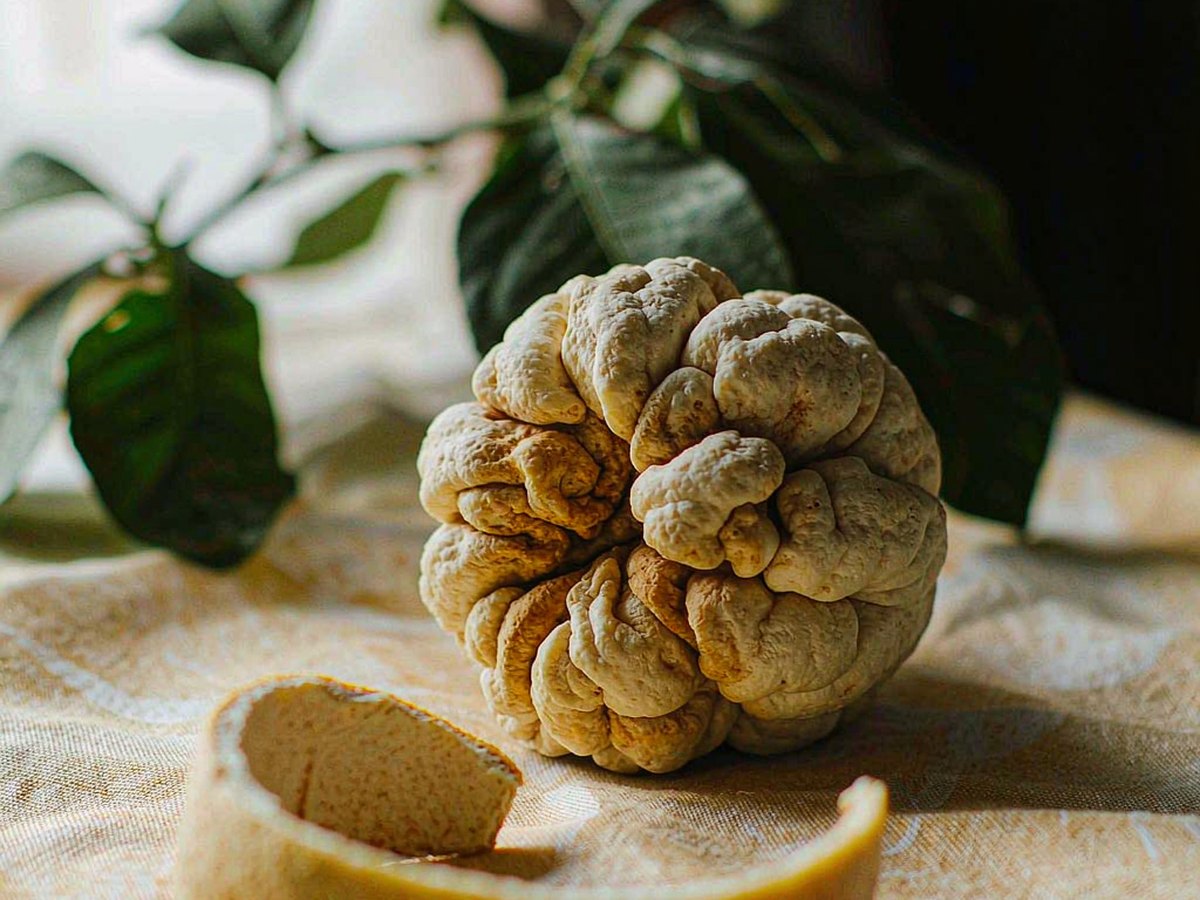
A citron is a lemon that has given up on being edible. The rind is enormously thick and full of pith, the pulp is small and nearly dry, and the whole point of the fruit is the fragrant oil in that rind. It is used in preserves, in tea, and as a room fragrance, and in Chinese medicine it is one of the classic qi-moving aromatics.
- Botanical
- Citrus medica — the citron, or Citrus medica var. sarcodactylis, which is the fingered Buddha’s hand. A very old cultivated citrus with almost no wild populations left.
- Part used
- The dried peel, or the whole dried fruit. The thick white pith is the bulk of the fruit and is not the aromatic part.
- Origin
- Yunnan, Sichuan, Guangdong and Guangxi in China; also Italy, Sicily and Greece, where the citron has been cultivated for well over two thousand years.
- Flavour
- Intensely floral and lemon-lime, with a slight resinous edge. Much more perfumed than an ordinary lemon.
- Use
- 2–3 g of peel per 200 ml, simmered 10 minutes. A thin strip of peel in a pot of tea gives a clear citrus lift.
- Keeps
- 18 months sealed. The thick pith protects the oils, which is one reason the citron has survived as a cultivated plant for millennia.
A fruit built for fragrance
Citron is probably the oldest citrus still in cultivation, and it is the least edible of them. Its rind can be two to three centimetres thick, nearly all pith, and its juice content is minimal — a few tablespoons at best. There is a reason it survived while its wild ancestors did not: people kept it for the oil and for the rind.
The oil content in the flavedo — the coloured outer layer — is very high, and it is what the food industry actually values. Citron oil, and the similarly used lemon oil, come from the same fruit family and are used in perfume, in liqueurs and in cosmetics.
In the kitchen this makes citron the classic candied citrus. Candied citron peel, a thick, chewy, translucent strip that is more substantial than candied lemon and stays sweet for months, is a genuine confectionery item rather than a decoration.
Xiang Yuan in the pharmacy
In Chinese medicine the citron, Xiang Yuan or Xiang Yuan Luo, is one of the oldest qi-moving aromatics in the book. It is used for distension, for a feeling of pressure in the abdomen, for nausea, and for the sensation of something stuck.
It shares its family and its function with the other citrus peels, and it sits between them: less aggressively bitter than qing pi, less mellow and less honeyed than aged chen pi, and more aromatic than either.
One classical use is worth knowing because it is unusual. Citron is the classical ingredient for what traditional medicine calls “phlegm” in the chest — a cough with a lot of loose, watery mucus and a sensation of something stuck in the throat. It appears in formulas for that pattern alongside other aromatics.
Storing and buying it
Dried citron peel should be pale cream to pale yellow on the outside, with a fibrous, corky white pith behind it. The whole dried fruit should feel hard and light and should smell sharply of lemon when you shake it near your nose.
The thing to watch for is age and dryness. Citron keeps its oils far better than most citrus peels, and a piece that has been properly dried will still be fragrant after a year. One that smells of nothing but cardboard has been exhausted.
Because the pith is so thick, a whole dried citron is heavy for its size and is usually sold as a decorative object or in slices. If you are buying for tea, buy the peel.
What it is used for
- Qi movement A classical aromatic used for distension, pressure and nausea, and for the sensation of something being stuck in the abdomen.
- Chest phlegm Traditionally used for a cough with watery mucus and a blocked sensation in the throat.
- Fragrance A very high oil content, which is why the fruit has been cultivated for its perfume for more than two thousand years.
- Digestion Used after meals for fullness, and in blends with aged tangerine peel.
- Candied peel The thick pith makes citron the best citrus for candying, and the resulting confection is a genuine sweet.
- Room and wardrobe scent A dried citron in a bowl or a drawer is a classic and effective fragrance.
In the kitchen
- Candied citron peel The classic use — thick strips simmered in syrup until translucent and chewy.
- Citron tea A thin strip of peel simmered ten minutes, or added to a pot of white tea.
- Digestive blend With aged tangerine peel and Sha Ren, taken after a heavy meal.
- Baking Thin strips of peel in a pan of biscuits or a cake, or candied peel on the top of a fruit tart.
- Fragrance A dried half in a shallow bowl in the hallway, or in a wardrobe drawer.
The white pith is the bulk of the fruit and it is bitter and slightly astringent. A thick slice in a cup will be much more bitter than a thin strip of peel, and it can be unpleasant.
C
i
t
r
o
n
i
s
a
w
a
r
m
,
m
o
v
i
n
g
a
r
o
m
a
t
i
c
a
n
d
t
r
a
d
i
t
i
o
n
a
l
s
o
u
r
c
e
s
a
d
v
i
s
e
c
a
u
t
i
o
n
d
u
r
i
n
g
p
r
e
g
n
a
n
c
y
a
n
d
i
n
p
e
o
p
l
e
w
i
t
h
a
s
e
n
s
i
t
i
v
e
g
u
t
.
A
n
y
o
n
e
o
n
m
e
d
i
c
a
t
i
o
n
s
h
o
u
l
d
a
s
k
a
c
l
i
n
i
c
i
a
n
b
e
f
o
r
e
u
s
i
n
g
i
t
r
e
g
u
l
a
r
l
y
,
a
n
d
i
t
s
h
o
u
l
d
b
e
k
e
p
t
a
w
a
y
f
r
o
m
c
h
i
l
d
r
e
n
a
s
a
c
o
n
c
e
n
t
r
a
t
e
d
a
r
o
m
a
t
i
c
.
Disclaimer
Citron’s traditional uses are recorded in Chinese medicine and are not established clinical indications. This article is written for a kitchen and a tea tray. Do not use citron to treat any condition, and consult a qualified practitioner before using it medicinally.