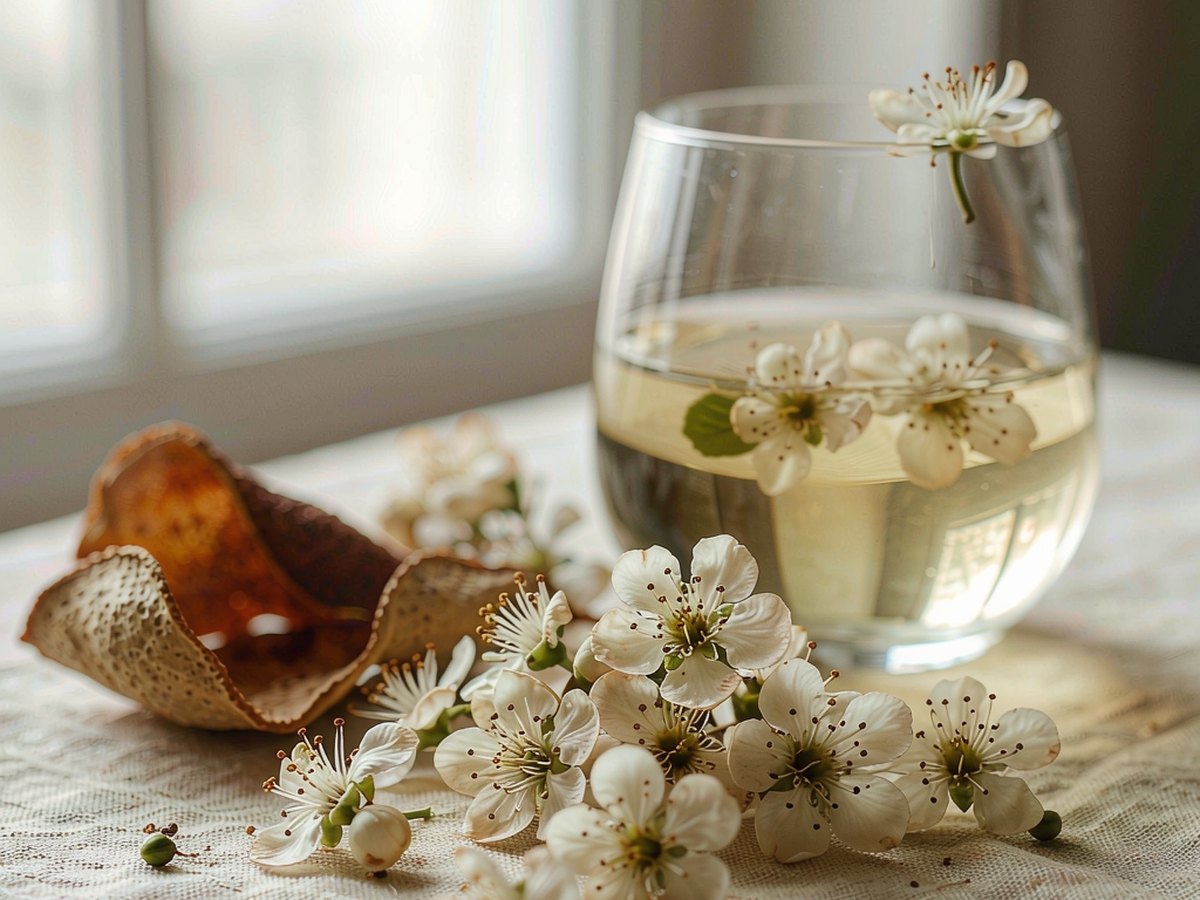
A citrus tree produces three things worth drying: the fruit, the peel, and the blossom. The fruit is the obvious one. The peel is the one the Chinese pharmacy has taken seriously for two thousand years. The blossom has been the quiet third — used for fragrance, for scenting tea and food, and, in classical practice, as the partner of the peel it grew beside.
- Botanical
- The flower of Citrus reticulata and its relatives — 橙花, chen hua — the small white five-petalled blossom of the mandarin and tangerine trees of the Chinese pharmacopoeia.
- Part used
- The dried whole flower, picked in spring in the brief window when the tree is in blossom.
- Origin
- Fujian, Guangdong, Zhejiang, Sichuan and Jiangxi. The best-known picking grounds are in the citrus-growing counties of Fujian and Guangdong.
- Flavour
- Intensely sweet and floral, with a green citrus note underneath and a faint bitter edge.
- Use
- 3–6 g per 200 ml, steeped 3–5 minutes in water just off the boil. It gives up its scent fast.
- Keeps
- 12 months sealed and dark. The aroma goes first, long before the colour does.
What the blossom actually is
The flower of the mandarin tree is small, white and intensely fragrant, and it opens for only a few days in early spring. In a good citrus-growing year a single tree will cover itself in blossom for perhaps a week, and the picking is done by hand, often in the early morning while the dew is still on it. The whole crop of a large county can be a few tonnes of fresh blossom, which dries down to a small fraction of that weight.
In the Chinese pharmacopoeia the material is called chen hua, the flower of Citrus reticulata, and it is recorded as aromatic, warm, and regulating of qi. It is not a herb you drink for its medicinal actions — it is a herb you reach for when a formula needs fragrance and lift, and when the digestion needs to be guided rather than pushed.
What makes the blossom interesting is that it belongs to the same plant as chen pi. The peel and the flower are two parts of one fruit, and the classical tradition treats them as complementary: the peel moves and guides, the flower harmonises and softens.
The relationship with chen pi
Understanding the blossom is much easier once you understand the peel, so if you have never read about aged tangerine peel, that is worth doing first. The short version is that the peel of the mandarin is aromatic, digestive, and regulating, and that its famous ageing process — chen pi is aged for three years or more before it is sold — is really about allowing the harshness of the fresh peel to soften while the aromatic compounds settle into a rounder profile.
The blossom enters the same tradition from the other side. It is the volatile, bright, floral half of the citrus plant, and it does what the aged peel does not: it lifts. Where chen pi is grounding and slow, the blossom is quick and fragrant.
Together they make one of the most-used pairings in Chinese tea practice. A slice of aged peel with a small pinch of dried blossom is a classic combination that has the depth of the peel and the lift of the flower. It is also, quietly, one of the best-smelling cups in this shop.
How it is picked, dried and stored
Quality blossom is picked when it is nearly open but not yet fully open, because a bud that has not opened has not yet released its scent, and a flower that has fully opened will have shed petals and lost its oil by the time it dries. The pickers work on the flower and the very young leaf together, which is why you sometimes find a small green leaf in the bag. That is normal and not a defect.
Drying is done in the shade, quickly, with warmth — sun-drying destroys the volatile oils that are the entire point, and shade-drying too slowly lets the flower brown and turn flat. Good dried blossom is a pale ivory to light straw colour with clearly visible petals and a powerful sweet scent when you open the bag.
Storage is where most people lose it. The scent will noticeably fade within a few months in an open bag, and after a year the material is decorative. Keep it in an airtight glass jar, in the dark, and use it within the year. It is also worth keeping a small amount in a separate jar so you can top up a blend that has gone flat.
A note on residues, and on strength
Two practical warnings. The first is agricultural: the flower is the most exposed part of the plant, it is often grown as an ornamental or for the fruit, and it is therefore the part most likely to carry residues. Buy from a supplier who tests, and be more careful with blossom than with a peel that has been washed and dried.
The second is strength. The blossom is powerful. Three or four flowers in a cup is a real amount; a spoonful is a perfumed, slightly bitter cup that most people will not want twice. And because it is a flower, it over-extracts quickly — five minutes in hot water is the upper limit, and long steeping turns it tannic and tea-tasting rather than floral.
What it is used for
- Regulating qi, classically The recorded classical use: aromatic and regulating, used in formulas where qi needs to move gently rather than be forced.
- Harmonising in a formula It is classically paired with chen pi, and it serves a technical role in classical formula composition as a harmoniser — the ingredient that helps the other herbs work together without dominating.
- Fragrance and lift in a tea Its clearest use in a kitchen: it adds a sweet, green, unmistakably citrus-floral top note that no peel can give.
- Aromatic food pairing Traditionally used to scent sweetmeats, syrups, rice dishes and tea, where the fragrance survives cooking better than most floral material.
- Digestive comfort It is classically used for the picture of a blocked or sluggish digestion with a feeling of fullness, always in combination rather than alone.
- Modern culinary use Used in modern pastry, confectionery and drinks as a natural floral citrus note, and it is one of the more useful florals for that particular job.
In the kitchen
- With aged chen pi A small piece of aged peel with four or five blossoms. The classic pairing and the single best-smelling cup in this guide.
- Straight blossom infusion Four blossoms in 200 ml just off the boil, steeped three minutes, then lifted out. Sweet, green, floral.
- Cold brew overnight Six blossoms in cold water, left in the fridge overnight. The cleanest expression of the scent, with no bitterness at all.
- With jasmine Three blossoms with a small amount of jasmine. Floral on floral, and the citrus lifts the jasmine rather than competing with it.
- Scenting a sugar A handful of blossoms mixed into caster sugar, sealed for a week and sieved out. The sugar keeps the scent for months.
- In a black tea base A few blossoms with a black tea or a dark oolong. The citrus note makes the darker leaf feel less heavy.
The blossom is aromatic and gently moving, which in classical terms means it is used with care in pregnancy and in anyone who is easily affected by moving herbs. Anyone with a citrus allergy should not use it at all.
I
t
i
s
a
l
s
o
w
o
r
t
h
b
e
i
n
g
c
a
r
e
f
u
l
w
i
t
h
s
o
u
r
c
i
n
g
,
f
o
r
t
h
e
r
e
s
i
d
u
e
r
e
a
s
o
n
a
b
o
v
e
.
A
n
d
i
n
p
r
a
c
t
i
c
a
l
t
e
r
m
s
:
i
f
y
o
u
a
r
e
n
e
w
t
o
t
h
e
m
a
t
e
r
i
a
l
,
s
t
a
r
t
w
i
t
h
t
h
r
e
e
b
l
o
s
s
o
m
s
.
T
h
e
s
c
e
n
t
i
s
s
t
r
o
n
g
e
n
o
u
g
h
t
h
a
t
a
c
a
r
e
l
e
s
s
h
a
n
d
f
u
l
p
r
o
d
u
c
e
s
a
c
u
p
t
h
a
t
t
a
s
t
e
s
o
f
s
o
a
p
,
w
h
i
c
h
i
s
a
r
e
a
s
o
n
a
b
l
e
o
u
t
c
o
m
e
b
u
t
a
d
i
s
a
p
p
o
i
n
t
i
n
g
o
n
e
.
Disclaimer
Dried citrus blossom is a fragrant traditional ingredient and a lovely thing to cook with. It is not a treatment for digestive complaints, anxiety, or any other condition, and the classical indications recorded above describe traditional practice rather than proven efficacy. Please talk to your doctor or pharmacist before making it a regular drink if you are pregnant or nursing, take medication, manage a chronic condition, or are giving it to a child.