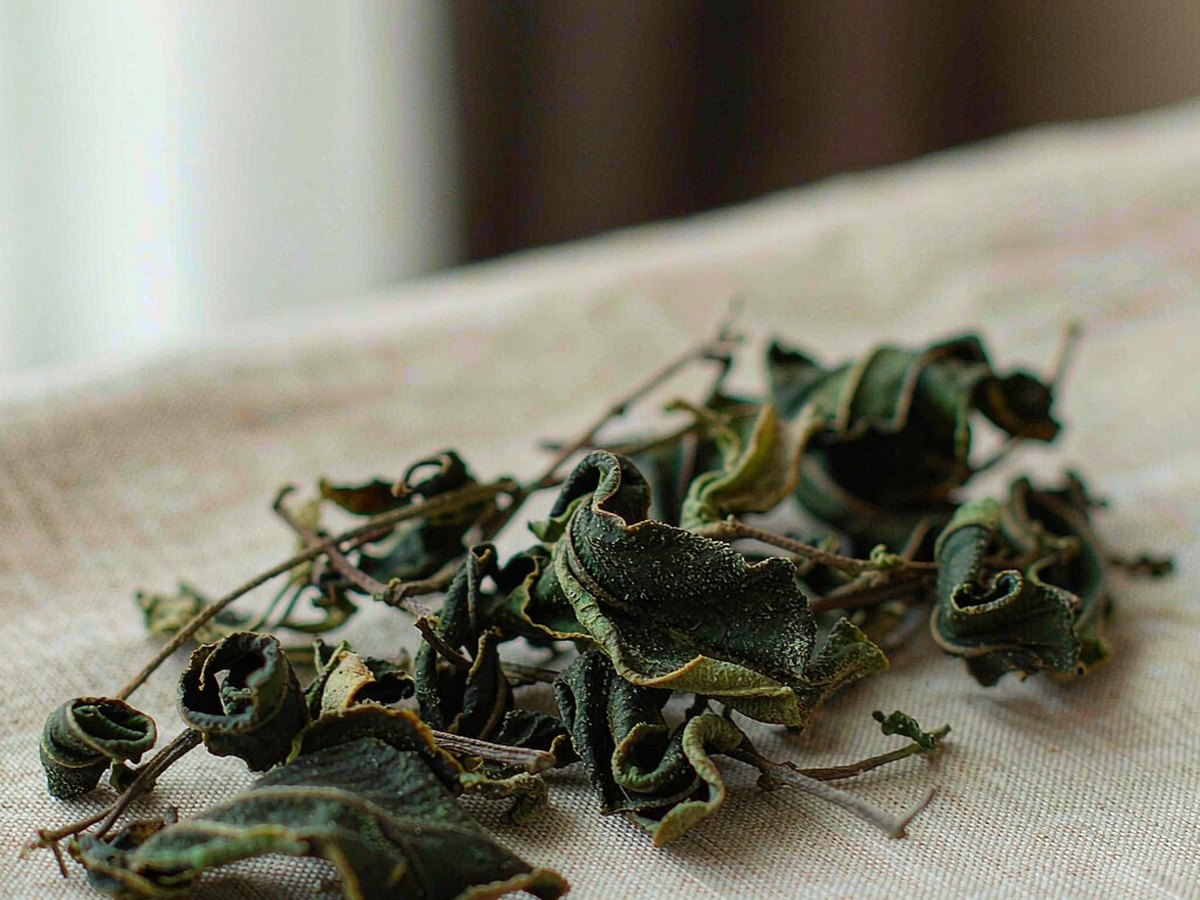
Vine tea, or ampelopsis tea, is made from the leaves of a wild climbing plant in the grape family, and it has been drunk as a herbal tea in Guangxi for a long time. It has also become a global weight-loss supplement, and the gap between those two facts is the whole story of this herb.
- Botanical
- Ampelopsis grossedentata — a woody climber of the family Vitaceae, the same family as the grape. It grows wild over hillsides in Guangxi and is now also cultivated.
- Part used
- The dried leaf, usually in a cut or rolled form. Vine tea is sometimes sold in a pressed brick.
- Origin
- Guangxi in southern China is the historical source, and it is also where the wild harvest still comes from. Japan and South Korea produce their own.
- Flavour
- Grassy and slightly astringent, with a faint, pleasant vegetal sweetness. It tastes rather like a light green tea.
- Use
- 3–5 g per 200 ml, 90–95 °C, 2–3 minutes. It re-steeps well and can be brewed four or five times.
- Keeps
- 12 months sealed and dark.
The tea, and where it comes from
In Guangxi, vine tea is a household drink, sold loose in the markets and drunk for the simple reason that it is good and it is cheap. The plant grows wild over the limestone hills, and the leaves are gathered, dried and sold in a loose, rolled form that looks a little like a low-grade green tea.
That is the honest history. It is a regional tea, and it is a pleasant one — grassy, slightly astringent, with a faint sweetness that comes from the leaf sugars rather than from any added sweetener.
It also has a strong, well-documented diuretic effect, which is why it is drunk through the summer in a hot, humid region. The traditional use is hydration and cooling, and the diuresis is a genuine feature of the plant.
The weight-loss claim, examined
Vine tea became a global weight-loss product in the 2010s, and the reason is a compound called dihydromyricetin, or ampabiletin. The marketing is built around it.
Here is what the research actually shows. Dihydromyricetin has genuine effects in animal models on lipid metabolism, on alcohol metabolism and on what is called AMPK activation, which is a real and well-studied pathway in energy metabolism. There are studies showing body-weight effects in animals fed a high-fat diet.
There is a small number of human trials, and they are short, small, and generally measuring markers rather than outcomes. The overwhelming majority of the evidence is in mice. There is no good clinical evidence that drinking vine tea produces meaningful weight loss in people, and the doses of dihydromyricetin used in the animal studies are considerably higher than what a cup of tea delivers.
The most defensible summary: vine tea is a pleasant, hydrating, mildly diuretic traditional tea, and its weight-loss reputation rests on research that has not yet been done in people.
Dihydromyricetin and the alcohol question
The most interesting strand of the vine tea research has nothing to do with weight. Dihydromyricetin has been studied for its effects on alcohol metabolism, in the context of what Chinese researchers call the hangover — and there is animal and some human evidence that it affects the enzymes involved in clearing alcohol.
The evidence is genuinely interesting and also genuinely preliminary. It does not establish that vine tea prevents or cures a hangover, and the mechanism is not the same as the mechanism by which alcohol causes one in the first place.
It is a good illustration of how a compound-based research story and a folk use can coexist without either one being established. Nobody should use vine tea to drink more safely, and nobody should use it to treat anything.
What it is used for
- Diuretic and hydration The traditional use and the most reliable effect: a mild, genuine diuretic, drunk through the hot months of a humid region.
- Diuretics and regularity Traditionally used for water retention and for promoting the flow of fluid.
- Dihydromyricetin research A real compound with real metabolic activity in animal models, and a small amount of human work. Not established as a weight-loss or health treatment.
- Alcohol metabolism research Studied for effects on the enzymes that clear alcohol. Interesting, preliminary, and not a basis for drinking more safely.
- Antioxidant activity Polyphenols with laboratory antioxidant activity, in a family of compounds that includes the one above.
- As a tea A genuinely good, mild, endlessly re-steepable regional tea that deserves to be drunk for being a tea.
In the kitchen
- Straight infusion Five grams at 90 °C for two minutes, re-steeped four or five times. It is built for repeated steeping.
- Cold brew overnight Ten grams in cold water for eight hours, which gives a clean, sweet, low-bitterness cold tea.
- Iced with lemon The most approachable version, and the way most people first meet it.
- After a heavy meal The traditional regional use, with the mild bitterness and the diuresis doing the work.
- Blending Half vine tea and half jasmine, which is a very good cup.
Because vine tea is a diuretic, it will increase urine output. Anyone already on a diuretic or on blood-pressure medication should be careful with it, and it can contribute to dehydration if you drink a lot of it in hot weather without replacing the fluid.
I
t
i
s
t
r
a
d
i
t
i
o
n
a
l
l
y
a
v
o
i
d
e
d
i
n
p
r
e
g
n
a
n
c
y
a
n
d
i
n
p
e
o
p
l
e
w
i
t
h
a
c
o
l
d
,
d
e
f
i
c
i
e
n
t
c
o
n
s
t
i
t
u
t
i
o
n
.
I
f
y
o
u
a
r
e
o
n
m
e
d
i
c
a
t
i
o
n
,
a
s
k
a
p
h
a
r
m
a
c
i
s
t
b
e
f
o
r
e
m
a
k
i
n
g
i
t
a
d
a
i
l
y
d
r
i
n
k
—
t
h
e
d
i
u
r
e
t
i
c
a
c
t
i
o
n
i
s
t
h
e
r
e
a
s
o
n
,
n
o
t
t
h
e
m
a
r
k
e
t
i
n
g
.
Disclaimer
Vine tea is a good regional tea with a real diuretic effect and a large body of animal research on dihydromyricetin that has not yet been replicated in people. It is not a weight-loss treatment and it is not an alcohol remedy, and no herb should be used in place of prescribed care.