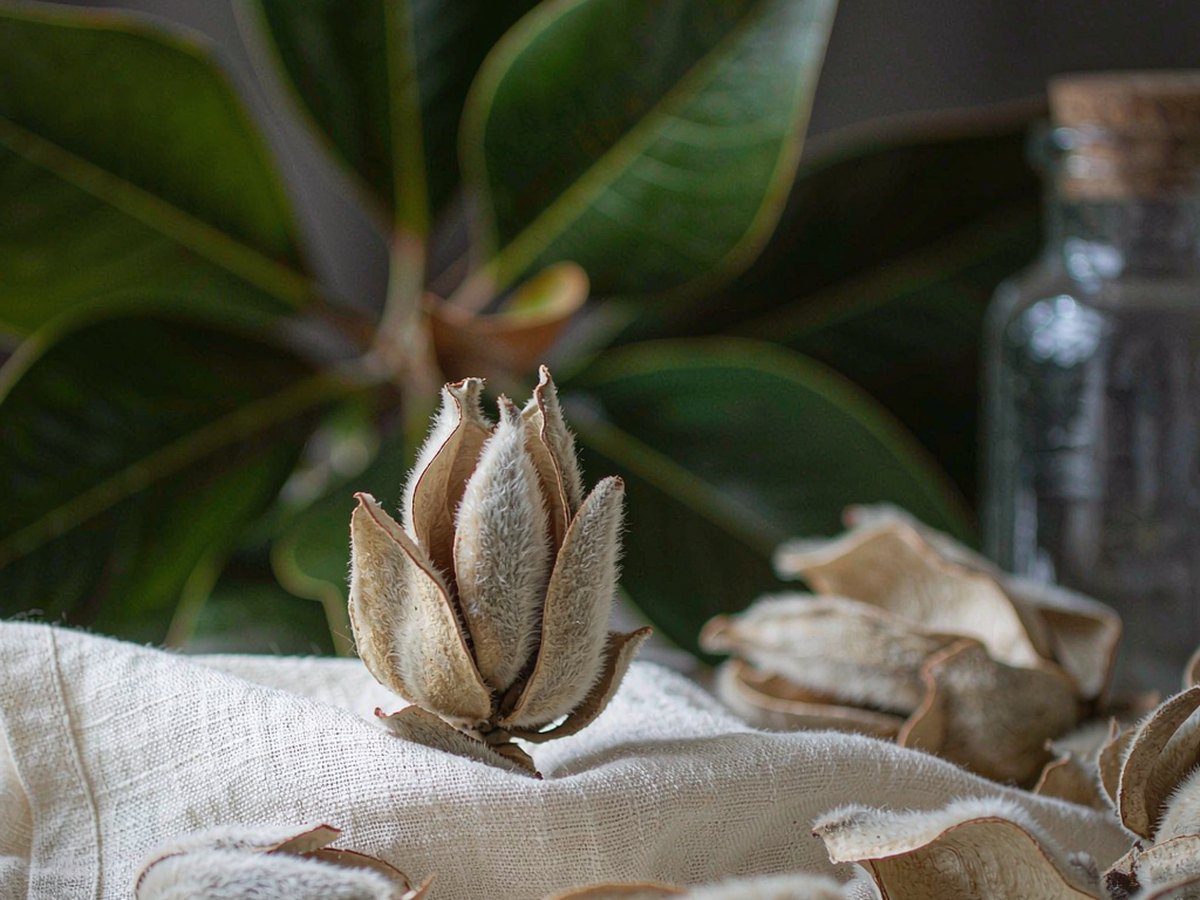
Magnolia bud is the one Chinese herb with a use that survived into modern western practice relatively intact. Its dried, hairy, spike-shaped flower buds are used for blocked noses, and they are one of the very few herbal ingredients that appears in both the classical Chinese pharmacopoeia and in contemporary drug labels in the West.
- Botanical
- Magnolia denudata (Yu Lan, the yulan magnolia, the usual source) and Magnolia biondii (Xin Yi, the subject of most Chinese pharmacy lots). Both are deciduous trees of the family Magnoliaceae.
- Part used
- The dried flower bud, picked before opening. The tomentose hairs on the bud are a defining feature and must not be removed.
- Origin
- Sichuan, Hubei, Henan, Anhui and Jiangsu grow most of the Chinese crop; Magnolia biondii from Henan and Shaanxi is the classic wild-harvested source.
- Flavour
- Acrid, pungent and slightly sweet, with a strange, almost garbanzo-like finish. It is not a pleasant-tasting herb.
- Use
- 1–3 buds per 200 ml, 85–90 °C, 3 minutes. Traditionally the buds are decocted rather than infused, and the decoction is sniffed rather than drunk.
- Keeps
- 12–18 months sealed. The hairs degrade with moisture and the buds must be kept completely dry.
What the hairs are doing
A magnolia bud is covered in fine, dense, silvery hairs. These are not a processing artefact — they are the plant’s own defence, and they are still present on the dried bud. Their relevance is practical: in a decoction, the hairs irritate the throat and the gastrointestinal tract, which is the main reason magnolia is a sniffed decoction rather than a drunk one.
The hairs are also why good magnolia is stored dry and why a damp bag is a ruined bag. Once the hairs clump, they can no longer be strained out and the decoction becomes unpleasant in a new way.
Commercially the hairs are sometimes singed off, which makes the herb more drinkable but also less traditional. It is worth knowing which you have if the tea is meant to be drunk rather than inhaled.
The two magnolias
Magnolia denudata, the yulan or lily magnolia, has large, white, upright, very fragrant buds and flowers. It is the tree grown as an ornamental in Chinese gardens, and its flowers are the most strongly scented of any magnolia.
Magnolia biondii, the xin yi or xiang yi, is the smaller wild tree whose pointed, hairy buds are the standard Chinese pharmacy drug. Its buds are narrower and less showy than yulan’s, and its flavour is more acrid.
Both are used for the same classical purpose and both are sold as “xin yi hua”. If you want the traditional pharmacy material, look for the small pointed buds of M. biondii from Henan and Shaanxi rather than the large garden magnolia buds.
How it is actually used
The classical method is a decoction: a handful of buds simmered in water for fifteen or twenty minutes, and the steam inhaled with a towel over the head. That is the traditional way to use it for a blocked or runny nose, and it is the reason the herb is described in Chinese medicine as opening the orifices.
Drinking it is a secondary use and it tastes bad — acrid, slightly sweet, and with a lingering aftertaste that most people find unpleasant. Blended into a larger pot with sweeter flowers and dried citrus, the harshness is diluted and it works well as a component rather than as a solo drink.
It is worth noting that the same herb appears in both Western herbalism and in traditional Chinese medicine for congested sinuses, which is one of the few places where the two traditions agree on the herb, the use, and roughly the preparation.
What it is used for
- Congested sinuses The best-established traditional use, in both Chinese medicine and Western herbal practice: a decoction inhaled as a steam for a blocked or runny nose.
- Opening the orifices Classified in Chinese medicine as an aromatic that opens the orifices and dispels wind, used specifically in patterns of facial blockage and a clear nasal discharge.
- Headache and sinus pressure Traditionally used for headache associated with sinus congestion, and for the sensation of pressure in the face.
- Aromatic A strongly scented, acrid aromatic that also appears in digestion blends for its warming dispersing quality.
- Antimicrobial The essential oil shows antibacterial and antifungal activity in laboratory testing.
- Traditional formulation Appears in a number of classical Chinese formulas for nasal and facial symptoms, and in modern Chinese patent medicines.
In the kitchen
- Steam inhalation Six buds simmered in a litre of water; inhale over the pot with a towel. The classical use, and the one that works best.
- Blended tea Two buds with chrysanthemum, dried citrus peel and a little rock sugar, to make the acrid note drinkable.
- Cold brew A single bud in cold water overnight gives a very gentle, lightly floral drink with none of the heat.
- Kitchen fragrance A few buds in a simmering pot of stock for a subtle, unusual lift — a modern use, and a good one.
- Sachet Traditionally used in sachets and hanging sachets for the room fragrance.
This is one of the more unpleasant herbs to drink straight, and the hairs are genuinely irritating to the throat and the stomach. Do not drink a strong magnolia decoction, and do not use it if the hairs have been stripped and the material is very fine — that combination should be sniffed, not swallowed.
M
a
g
n
o
l
i
a
b
u
d
i
s
n
o
t
n
o
r
m
a
l
l
y
g
i
v
e
n
t
o
c
h
i
l
d
r
e
n
,
a
n
d
i
t
i
s
u
s
e
d
w
i
t
h
c
a
u
t
i
o
n
i
n
p
r
e
g
n
a
n
c
y
i
n
t
r
a
d
i
t
i
o
n
a
l
p
r
a
c
t
i
c
e
.
I
f
y
o
u
t
a
k
e
a
n
y
m
e
d
i
c
a
t
i
o
n
r
e
g
u
l
a
r
l
y
,
a
s
k
a
c
l
i
n
i
c
i
a
n
b
e
f
o
r
e
u
s
i
n
g
i
t
a
s
a
d
a
i
l
y
d
r
i
n
k
.
Disclaimer
Magnolia bud has real evidence of activity against nasal symptoms in laboratory and some clinical work, but this article is written for a tea tray, not for a pharmacy. It is not a treatment for sinusitis, hay fever or a chest infection, and it should never replace medical care for a persistent or severe nasal problem.