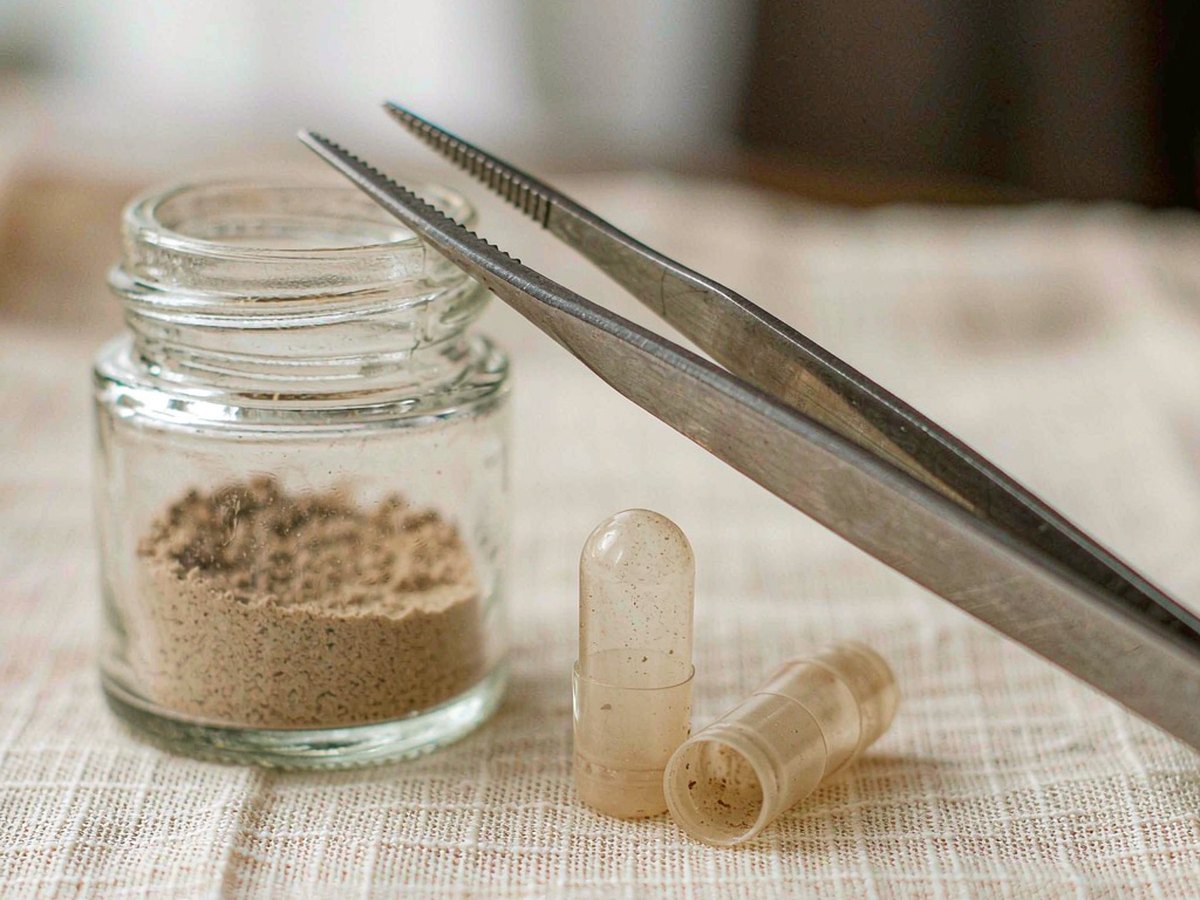
Hand-Filled Capsules explained: what it is, how to pick it, and what actually matters when you use it.
A capsule is a dose of powder in a shell you can carry, and that simplicity is the whole appeal. It is also the whole risk. Hand-filling is the easiest way to make a herbal remedy a daily habit, which is exactly why it deserves a method rather than an improvisation.
- What they are
- Empty capsules, most commonly made from plant cellulose (hypromellose) or from pullulan, in a range of sizes that determine the powder capacity of each one.
- The usual sizes
- Size 00 holds roughly 300–400 mg of fine powder; size 0 about 400–500 mg; size 1 about 300–400 mg. The numbers vary with grind density.
- Material
- Vegetarian capsules are made from hydroxypropyl methylcellulose and are clear, gelatin-free, and dissolve in the stomach. Gelatin capsules are also common and are generally cheaper.
- Best used for
- Fine powder, and only fine powder. Coarse material will not pack and will jam the machine or the capsule.
- Storage
- Sealed in a cool, dry place, away from heat and light. Fill them fresh rather than months ahead if you can.
- Why it matters
- Portability and dosing consistency. The caveat is that it makes a daily habit easy, and easy daily habits are exactly what you want to be careful about.
Why people reach for capsules
There are three good reasons, and they are all practical. The first is dosing: a capsule holds a measured weight, which is far more consistent than a spoonful of anything loose. The second is portability: a week of doses in a small bottle is the difference between taking your herbs and not taking them. The third is taste — some of the most useful herbs are bitter enough that a capsule is a kindness to yourself.
There is also one bad reason, which is worth naming: to avoid thinking. A capsule is a thing you swallow without thinking about the dose, without thinking about whether you still need it, and without the daily ritual of measuring that forces you to reconsider. That is convenient right up until it becomes three months of something you started for a reason you have forgotten.
The habit is not the problem. Unconsidered habit is the problem. A capsule makes it easier to keep taking something you should have stopped, which is an argument for writing down what the capsules are and why, at the moment you fill them.
The one-third rule, and why it is the whole trick
Herbal powders expand. Many root and seed powders absorb moisture and swell, and if you pack a capsule completely full, that swelling splits the shell, or the join separates, and you get a mess in your pocket and a dose you did not intend.
The standard technique is to fill each capsule to roughly one third of its capacity with fine powder, pack it down gently with the tamper, and repeat until it is firm and level. The remaining two thirds is what allows for the swelling. It is why a box of size 00 capsules holds less powder than the printed capacity suggests, and it is why two one-third capsules give you a more reliable result than one packed-full capsule.
If you are packing by hand, the tamper is the important tool — the flat end of a small spatula or the cap from a marker works, but a proper tamper makes a much more consistent job. If you are packing with a machine, the same principle applies and the machine will normally have its own fill setting that you adjust down rather than to maximum.
Which herbs should not go in a capsule
Not all herbal powders are suitable, and there are two categories to be careful about. The first is bulk and volume: a herb like goji berry or jujube, when dried and ground, needs several capsules to deliver a meaningful amount, and swallowing four capsules to get the equivalent of one jujube is a poor trade. Whole fruit is better eaten.
The second is safety, and this matters more. Capsules are a delivery mechanism that hides what is inside — from you, at the moment of taking it. That is exactly the property that makes them dangerous for the herbs where the dose range between medicinal and toxic is narrow, or where the herb interacts with medication in a way you would remember if you were measuring a spoonful of something bitter every night.
There is a third practical caution: capsules are not ideal for anything you want to taste. An herb whose whole point is its aromatic quality — cardamom, tsaoko, the citrus peels, fennel — belongs in a pot where you can smell it and adjust the amount. Grind those only if you are putting them in food.
Making it into a routine that you can still stop
The best small practice is to fill no more than a week at a time, and to write the name and the date on the bottle. If you cannot remember what is in it, you should not be taking it, and a bottle with no label is how that happens.
Second, keep one batch unopened. A capsule that has been sitting sealed for months has had time to do nothing good, and dried material does not improve in a capsule any more than it does in a jar.
Third, and this is the practical health point: capsules are not a way around the caution on the herb itself. If the herb is contraindicated for you, it does not become safe because it is in a shell. If you are pregnant, on medication, managing a chronic condition, or giving it to a child, the same conversation with a clinician is required whether the herb is in a teapot or a capsule.
What it is used for
- Consistent dosing The main practical reason: a measured weight of powder is repeatable, which a spoonful of loose herb is not.
- Portability A week’s doses in a small bottle is the difference between a remedy you actually take and one you abandon.
- Avoiding the taste For genuinely bitter herbs, the shell removes the taste entirely, which makes a bitter medicine easier to take consistently.
- Travel and discretion Capsules go in a bag without a mortar, without loose powder, and without the smell of a decoction in a hotel room.
- Controlled single-herb intake A capsule makes it straightforward to take one specific herb rather than a blend, which is useful when you are testing how one ingredient sits with you.
- Not a bypass Capsules change the delivery, not the medicine. Every contraindication and interaction that applies to the loose herb applies identically to the filled one.
In the kitchen
- A week at a time Fill seven capsules, label the bottle with the herb and the date, and refill as needed. This keeps the material fresher and makes it obvious if you have stopped needing them.
- The one-third fill Fine powder only, packed to about a third of the capsule’s capacity, tamped down firmly, repeated until full.
- Size 00 for roots, size 0 for leaves Denser root and bark powders fit better in the smaller size 00 capsule; fluffy leaf material takes the larger size 0 and still may not pack well.
- With a meal Many herbal capsules are taken with food, which matters for anything irritating to an empty stomach.
- Capsules alongside a tea The most useful habit is not replacing the pot but making the daily dose possible — the decoction you make with care on Sunday, portioned into capsules for the week.
- Marking the bottle Herb name, date, and a one-line note on what it is for. Three seconds of work that prevents three months of uncertainty.
Everything that applies to the herb applies to the capsule. Capsules do not change a herb’s safety profile, they only change how it is delivered and how easy it is to take without thinking — which is the point where most problems come from.
P
r
a
c
t
i
c
a
l
c
a
u
t
i
o
n
s
s
p
e
c
i
f
i
c
t
o
t
h
e
f
o
r
m
a
t
:
c
a
p
s
u
l
e
s
a
r
e
e
a
s
y
t
o
s
w
a
l
l
o
w
a
c
c
i
d
e
n
t
a
l
l
y
b
y
a
c
h
i
l
d
,
a
n
d
t
h
e
y
l
o
o
k
l
i
k
e
s
w
e
e
t
s
.
K
e
e
p
t
h
e
m
o
u
t
o
f
r
e
a
c
h
a
n
d
d
o
n
o
t
d
e
s
c
r
i
b
e
t
h
e
m
a
s
s
w
e
e
t
s
.
I
f
y
o
u
u
s
e
a
n
e
n
c
a
p
s
u
l
a
t
i
n
g
m
a
c
h
i
n
e
,
c
l
e
a
n
i
t
t
h
o
r
o
u
g
h
l
y
b
e
t
w
e
e
n
h
e
r
b
s
,
s
i
n
c
e
r
e
s
i
d
u
a
l
p
o
w
d
e
r
f
r
o
m
a
p
r
e
v
i
o
u
s
b
a
t
c
h
w
i
l
l
c
o
n
t
a
m
i
n
a
t
e
t
h
e
n
e
x
t
o
n
e
a
n
d
t
h
e
r
e
i
s
n
o
w
a
y
t
o
t
e
l
l
b
y
l
o
o
k
i
n
g
a
t
t
h
e
f
i
n
i
s
h
e
d
c
a
p
s
u
l
e
.
Disclaimer
Capsules are a delivery format, not a treatment and not a safety device. Nothing here should be read as a claim that any herb will treat a condition, and no herb in a capsule should replace prescribed care. If you are pregnant or nursing, take prescription medication, manage a chronic condition, or are giving herbs to a child, talk to your doctor or pharmacist before making any of this a daily habit.