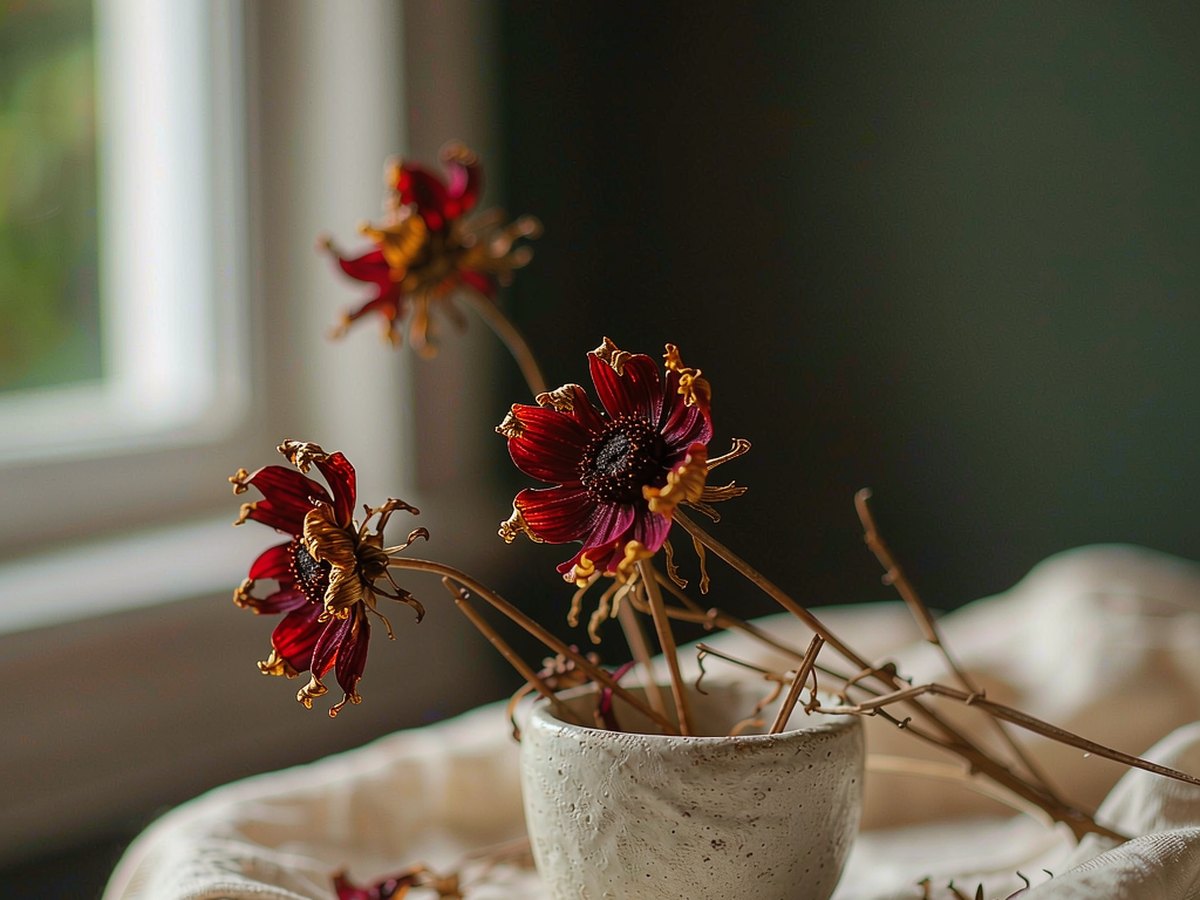
Snow chrysanthemum, xue ju, is sold next to real chrysanthemum in every Chinese tea shop and is not closely related to it. It is Coreopsis tinctoria, a daisy from the American prairie that grows wild across Xinjiang and has become a speciality of the Kashgar region. The cup it makes is a deep red-gold and tastes of wood, honey and a little smoke.
- Botanical
- Coreopsis tinctoria — a different genus from Chrysanthemum, though both sit in the daisy family (Asteraceae). Chinese tea trade calls it xue ju, or Yuk Hue.
- Part used
- The whole dried flower head, with petals and the dark central disc still attached.
- Origin
- Xinjiang — Kashgar, Hotan and Yarkand — where it grows as a wild crop in the desert fringe and is harvested by Uyghur families. Also grown in Yunnan.
- Flavour
- Honey, wood, a faint smokiness and a clean vegetal note. Much less floral and much less bitter than true chrysanthemum.
- Use
- 5–8 flowers per 200 ml, 90–95 °C, 3–4 minutes. One flower per cup is a light brew; five is a dark, coppery one.
- Keeps
- 18 months sealed and dark. It does not fade quickly the way yellow chrysanthemum does.
What the pigment actually is
The deep red-gold colour comes from anthocyanins, the same class of pigments that make blueberries and red cabbage their colour. Anthocyanins are pH-sensitive, and the brewing water matters: slightly alkaline water shifts the colour toward red and deeper; slightly acidic water pulls it toward orange and the cup fades faster.
That is worth knowing for a second reason. Anthocyanins are the subject of a large antioxidant literature, and Coreopsis tinctoria is specifically studied as a source of them — the plant also produces TCMI and aureusidin, which are unusual carotenoid derivatives. Laboratory antioxidant capacity is not the same as a health benefit you can count on from a cup of tea, and the research on this plant is overwhelmingly in vitro and in animal models rather than in people.
Xinjiang and the Uyghur tea tradition
Coreopsis grows wild in the desert margins around Kashgar and Hotan, where it has been gathered for centuries. The Uyghur and Kazakh communities of the region drink it as a house tea, and it became a commercial speciality once the quality of the wild-harvested crop was recognised.
The important thing to know about provenance here is that wild-harvested Kashgar lots and cultivated lots are very different products. The wild crop grows slowly in cold, dry, high-altitude conditions, which concentrates the pigment and the flavour. A cultivated Coreopsis from a warmer, faster-growing farm is a lighter, less interesting flower that happens to be the same species.
Look for lots that state Xinjiang or Kashgar, and expect to pay more for them. There is also a green-tinged, less pigmented grade that is sometimes sold as an adulterant and brews a weak yellow-brown rather than copper.
How it compares to real chrysanthemum
Yellow chrysanthemum is pale, floral and cooling, with a distinct bitterness that comes from compounds in the flower head. Snow chrysanthemum is darker, woodier, more aromatic and — this surprises people — noticeably less bitter, though it has a different bitterness of its own that arrives later and is drier.
The two also behave differently in the pot. Chrysanthemum gives up its character quickly and fades after two or three minutes. Coreopsis holds its aroma through several infusions and actually deepens over the second cup, which is why it works well as a base for a multi-steep session.
What it is used for
- Antioxidant content Coreopsis tinctoria is a rich source of anthocyanins and of unusual carotenoid derivatives. Laboratory and animal studies show strong antioxidant activity; human clinical evidence for drinking it is not established.
- Traditional use In Chinese practice it is used as a cooling, heat-clearing herb, and in the Xinjiang tradition as an everyday house tea.
- Blood pressure and circulation Traditionally used for high blood pressure in Chinese practice, and one of the more common reasons people buy it. There is no established clinical dosing and it is not a substitute for prescribed treatment.
- Eye and cardiovascular traditional uses Recorded in Chinese materia medica for eye complaints and for blood conditions. These are historical uses, not established indications.
- Flavour and aroma Its real kitchen value: a deep, woody, honeyed cup that is closer to a fine black tea in character than to a floral infusion.
- Colour A naturally coppery-red infusion that gives a blend a distinctive hue, which is a large part of why it is bought for blending.
In the kitchen
- Straight infusion Six flowers in 200 ml at 90 °C for four minutes. The second infusion is usually the best.
- With white tea Two flowers added to a pot of shou mei. The Coreopsis brings the colour and the depth.
- Cold brew Six flowers in cold water for four hours in the fridge gives a sweet, smooth, coppery drink with no bitterness at all.
- Blending One part Coreopsis to three parts chrysanthemum makes a darker, more balanced floral blend.
- Visual garnish A whole flower floating in a clear glass pot is the reason many people buy it.
Coreopsis and chrysanthemum are both in the daisy family, so if you react to ragweed, daisies or chrysanthemums you may react to this as well. Coreopsis is also closely related to Bidens, and people sensitive to that plant have reported reactions here too.
B
e
c
a
u
s
e
i
t
i
s
w
i
d
e
l
y
t
a
k
e
n
f
o
r
b
l
o
o
d
p
r
e
s
s
u
r
e
,
p
e
o
p
l
e
o
n
b
l
o
o
d
–
p
r
e
s
s
u
r
e
m
e
d
i
c
a
t
i
o
n
s
h
o
u
l
d
a
s
k
a
c
l
i
n
i
c
i
a
n
b
e
f
o
r
e
d
r
i
n
k
i
n
g
i
t
d
a
i
l
y
.
A
n
t
h
o
c
y
a
n
i
n
s
c
a
n
a
l
s
o
a
f
f
e
c
t
b
l
o
o
d
c
l
o
t
t
i
n
g
,
w
h
i
c
h
m
a
t
t
e
r
s
i
f
y
o
u
t
a
k
e
a
n
t
i
c
o
a
g
u
l
a
n
t
s
.
Disclaimer
Coreopsis tinctoria is a traditional herb and a genuinely interesting plant, but the antioxidant and blood-pressure claims attached to it come almost entirely from laboratory and animal research. It is not a treatment for high blood pressure or any other condition, and it must never be used in place of prescribed medication. Talk to your doctor before making it a daily drink if you take medication.