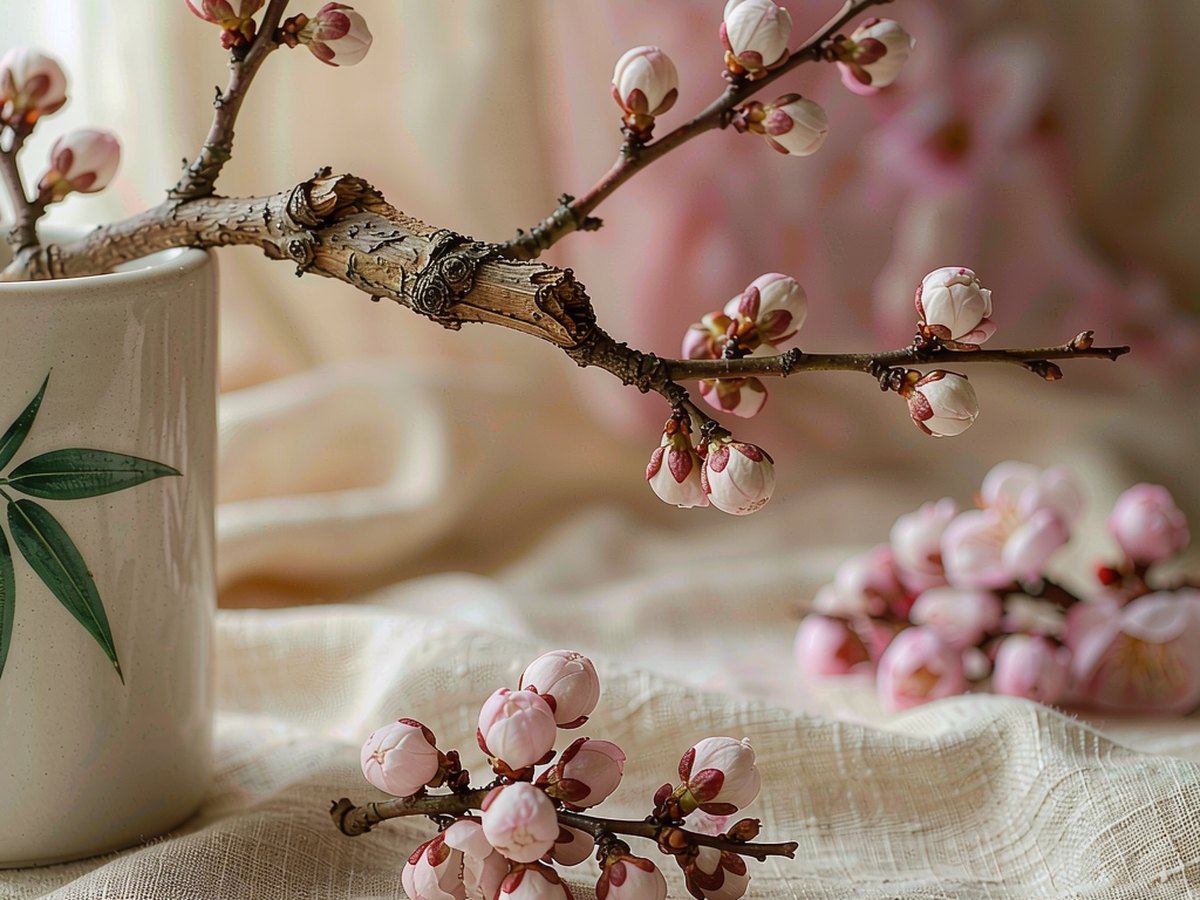
Plum blossom is unusual among dried flowers: it is picked as a bud, it is one of the first things to bloom in the cold, and the traditional way to use it is not as a tea at all but as a scent — in sachets, in a bathing ritual, and finally as the last thing drunk from a pot of water that the flowers have been steeping in.
- Botanical
- Prunus mume — the Chinese plum or Japanese apricot, a deciduous tree of the rose family, closely related to the plum and the apricot.
- Part used
- The dried flower bud, picked before opening. Open flowers are too fragile and lose their scent within hours.
- Origin
- Sichuan, Hubei, Anhui and Jiangsu have the largest plantings; also Taiwan, Korea and Japan, where it is a cultural emblem rather than only a tea.
- Flavour
- Delicate, lightly sweet, with an apricot and almond note and a faint green tea quality underneath.
- Use
- 3–5 buds per cup, 85–90 °C, 2–3 minutes. Also used in larger quantities as a scenting steep rather than as a drink.
- Keeps
- 12–18 months sealed and dark. Buds keep their colour and scent far better than open flowers.
The scenting steep
The classic Chinese preparation is not a cup you drink so much as a room you scent. Dried plum blossoms are steeped in hot water in a bowl or a wide vessel, and the steam carries the scent into the room while the water sits. This is the same idea as the osmanthus scenting bath, and it is how plum blossom was used in the scholar’s studio and in the women’s quarters of the house — as an aromatic rather than a medicine.
The drink that comes from it is a genuine second-best use. The water picks up a light floral sweetness and a very pale gold colour, and it is pleasant but faint, which is exactly why the flower is used in quantity when it is used this way.
Buds versus open flowers
A closed bud holds essentially all of the flower’s scent because the petals have not yet opened and the volatile oils have not dispersed into the air. Once a bud opens, the scent goes out into the room instead of staying in the material.
Good dried plum buds are small, tight, and plump, with a pale pink to pinkish-brown colour and a distinct little hook or stem at the base. Open petals sold as “dried plum blossom” are a different, weaker product — attractive for craft work, thin on scent, and worth noticeably less.
Many buds sold as plum blossom are actually plum or apricot blossom from ornamental varieties rather than from Prunus mume. They look almost identical. The distinguishing feature is the smell: Prunus mume has a stronger, more apricot-like perfume, and its buds are usually smaller and more rounded.
Cold-season flowering, and what it means
Plum is the earliest of the three winter “three friends of winter” — plum, pine and bamboo. It flowers on bare wood before the leaves appear, and in Chinese culture that is a symbol of resilience and of the year turning. It is also why plum blossom is associated with the beginning of the year and with the lantern festival.
In the pharmacy, plum blossom and plum blossom bud (Mei Hua, Mei Tuo Hua) are both recorded, the bud more commonly, and are used classically for what Chinese medicine calls regulating qi and relieving distension — a movement of stagnation in the middle burner, with a pleasant aromatic quality that keeps them from being harsh.
What it is used for
- Fragrance and mood The oldest and most consistent use. The scent is used to scent rooms, sachets and clothing, and is part of the classical four-fragrance repertoire of Chinese households alongside orchid, rose and chrysanthemum.
- Qi regulation In Chinese medicine, plum blossom is used to move stagnant qi and relieve distension, and to calm a feeling of constraint in the chest or abdomen.
- Digestive comfort Traditionally taken after meals for a feeling of fullness, and used to settle a sluggish digestion.
- Cough and throat A mild expectorant and aromatic use in Chinese practice, and the basis of the common winter tea of plum blossom with dried tangerine peel.
- Astringency A mild astringent and cooling quality that gives the infusion its clean, slightly drying finish.
- Seasonal drinking The blossom of the eighth lunar month, drunk in the weeks around the lantern festival as a seasonal marker.
In the kitchen
- Scenting steep A handful of buds in a bowl of hot water, set in the middle of the table. The room does the work.
- Plum blossom and chen pi tea Three buds with a small piece of dried tangerine peel — the classic winter combination.
- Cold brew Six buds in cold water for three hours gives a delicate, faintly apricot drink.
- Sachets and potpourri The classic domestic use, in a small muslin bag with a little sandalwood or dried citrus.
- Sugar and syrup Flowers infused into syrup for a pale pink glaze on sweets and for a jasmine-like drink.
- Tea blending Two or three buds added to a green or white tea give a floral lift without overwhelming the leaf.
Prunus mume is in the rose family, so people with an established nut or stone-fruit allergy should be cautious, and the kernels of the pit contain amygdalin and must never be eaten — the flower and the fruit flesh are the edible parts.
I
f
y
o
u
a
r
e
p
r
e
g
n
a
n
t
o
r
n
u
r
s
i
n
g
,
t
r
a
d
i
t
i
o
n
a
l
p
r
a
c
t
i
c
e
a
d
v
i
s
e
s
a
g
a
i
n
s
t
p
l
u
m
b
l
o
s
s
o
m
,
a
n
d
a
n
y
o
n
e
o
n
m
e
d
i
c
a
t
i
o
n
s
h
o
u
l
d
a
s
k
a
c
l
i
n
i
c
i
a
n
b
e
f
o
r
e
d
r
i
n
k
i
n
g
i
t
r
e
g
u
l
a
r
l
y
.
Disclaimer
This article describes a fragrant edible flower and its traditional use in Chinese households and medicine. Nothing here is a claim that plum blossom treats any condition, and no herb should be used in place of prescribed treatment. Please consult a clinician before using any herb medicinally, particularly during pregnancy.